
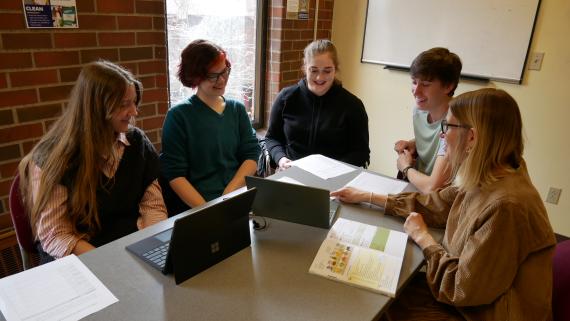
As part of its Baltic Studies program, the Department of Scandinavian Studies at the University of Washington offers two years of classroom instruction in Latvian as well as an opportunity for continued independent study of the language. A broad array of courses related to Latvia and the Baltics are also offered including a survey of Latvian literary and cultural history. Students majoring in Scandinavian Area Studies may select Latvian as their language of emphasis, and Latvian may also be a focus of those who do graduate work leading to the M.A. and Ph.D. in Scandinavian Studies.
Related Faculty
 Acting Instructor of Latvian
 Kazickas Family Endowed Professor in Baltic Studies; Associate Professor of Baltic Studies; Director, Center for European, Russian, and Eurasian Studies, Jackson School of International Studies
Latest News
- UW Study Abroad Fair (January 20, 2026)
- Solvita Burr publishes new book Ceļvedis pilsētu tekstu izpētē (A Guide to Exploring City Texts) (January 24, 2021)
- Baltic Studies Program celebrates 25th Anniversary (December 11, 2019)
- Tija Iles - B.A. & Minor, 2016 (October 2, 2019)
- 30 years later, the human chain that 'unshackled' the Baltic nations still matters (August 23, 2019)
Related Research
- Burr, S. (2023). Learning a foreign language and locality through an animated documentary film. Language Learning & Technology, 27(2), 199–225. https://hdl.handle.net/10125/73509
- Burr, S., Griķe, A.E., Krieviņa, K. (2022). Look at the graves!: Cemeteries as Guided Tourism Destinations in Latvia. In: Tara Thomson, Anne Schwan (Eds.). The Palgrave Handbook on Digital and Public Humanities, 459-477
- Pošeiko, S. (2018). Glocal Names in the Linguistic Landscape of the Baltic States. In: Multilingualism in the Baltic States: Social Discourses and Contact Phenomena (eds., S.Lazdiņa, H.F. Marten). Palgrave macmillan. pp. 369 - 405.
- Pošeiko, S. (2018). “Following footsteps of names”: Commercial Ergonymia in Linguistic Landscape of the Baltic Countries. In: Cotticelli Kurras, P., Alfredo Rizza, A. (eds., 2018). Language, Media and Economy in Virtual and Real Life. New perspectives. Cambridge Scholars Publishing. pp. 99–122.
- Pošeiko, S. (2018). The Linguistic Landscape as a Tool for Mastering and Improving Pragmatic Competence. In: Laiveniece, D. (ed.). Problems of and Perspectives on Language Acquisition. Cambridge Scholars Publishing, pp. 254–265.
- Guntis Šmidchens, Dziesmu vara: Nevardarbīga nacionālā kultūra Baltijas dziesmotajā revolūcijā. Latvian Translation of Power of Song, 2014. Riga, Latvia: Apgāds Mansards, 2017.
- Guntis Šmidchens, "Singing Revolution, Past and Present" Foreign Policy Research Institute Baltic Bulletin, 12 October 2016
- Pošeiko, S. (2015). The Latvian language in the Linguistic Landscape of Daugavpils (The middle of the 19th century – nowadays). Journal of Education, Culture and Society 2. pp. 320–336.
- Pošeiko, Solvita (2015). Valodas un to funkcionalitāte publiskajā telpā: lingvistiskā ainava Baltijas valstīs.// Language and its functionality in the urban public space: Linguistic landscape of the Baltic states. Riga: LU. https://dspace.lu.lv/dspace/handle/7/31349
- Guntis Šmidchens. The Power of Song: Nonviolent National Cultures in the Baltic Singing Revolution. University of Washington Press and Museum Tusculanum Press, 2014.